
Molded Pulp Egg Cartons — Eco-Friendly Packaging for Every Scale
From Backyard Farm to Commercial Distribution, We’ve Got You Covered
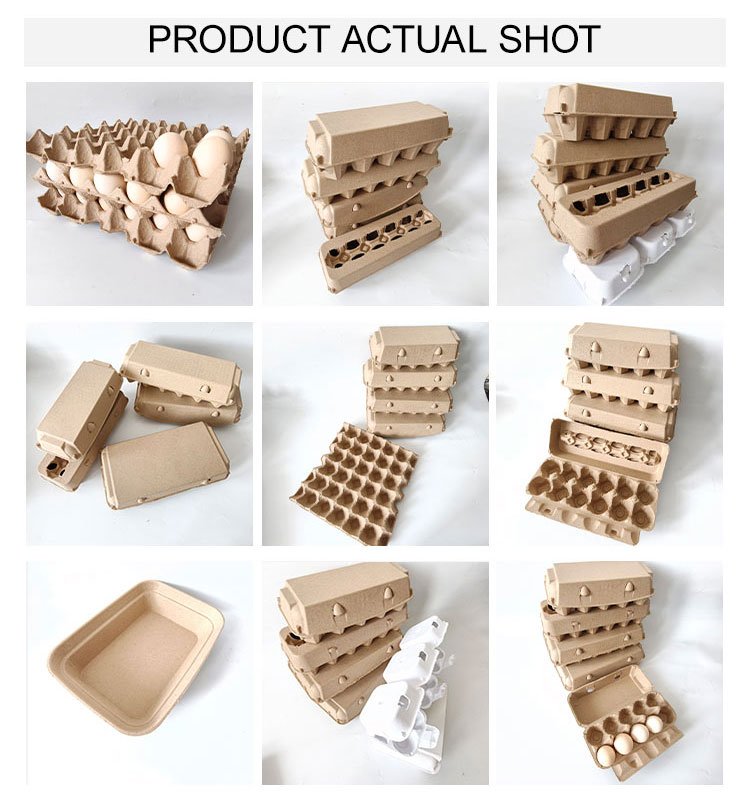
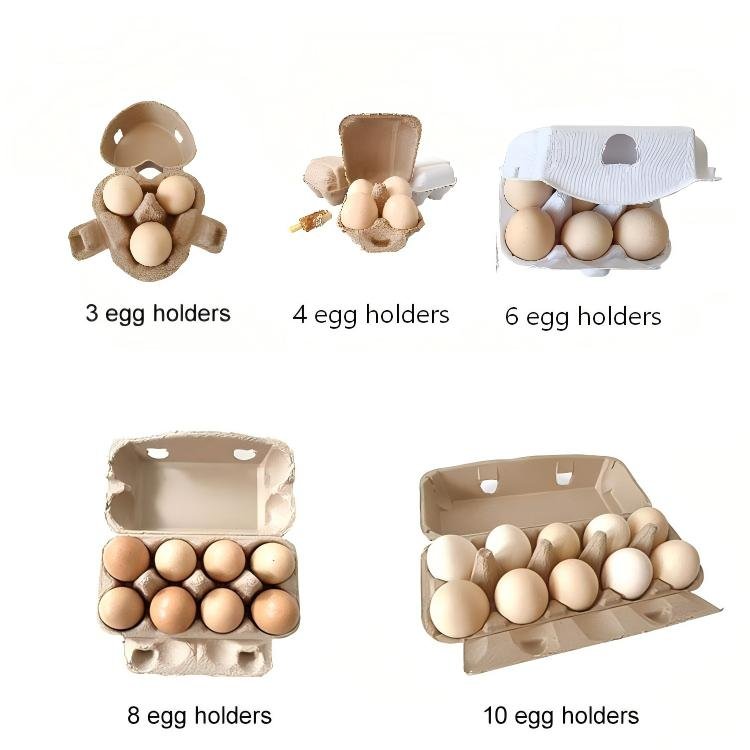
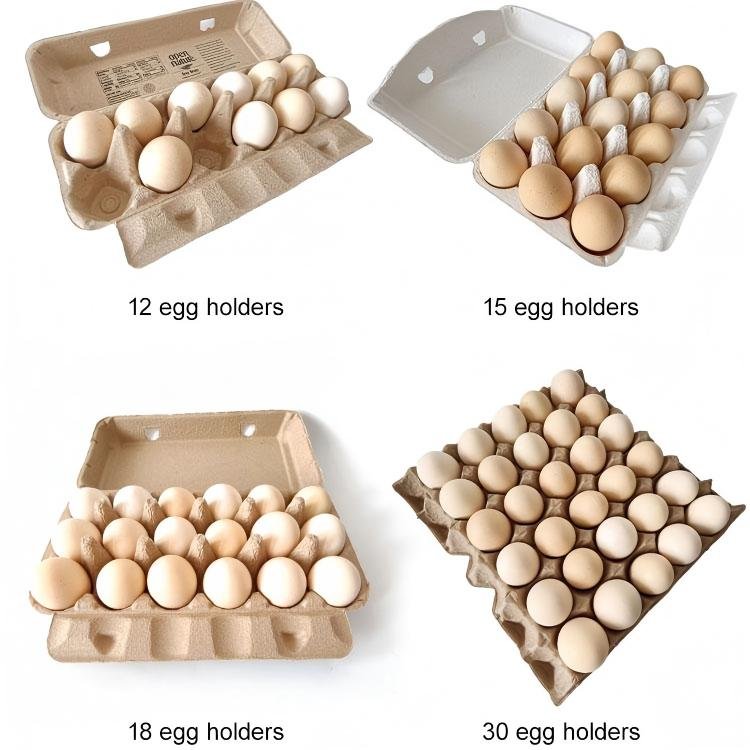
Our molded pulp egg cartons are crafted from 100% recycled paper fiber, delivering superior protection for your eggs while keeping your brand aligned with today’s sustainability demands. Available in 8 versatile sizes — 3, 4, 6, 8, 10, 12, 18, and 30 cells — we serve everything from boutique farm stands to high-volume commercial egg distributors.
Why Molded Pulp?
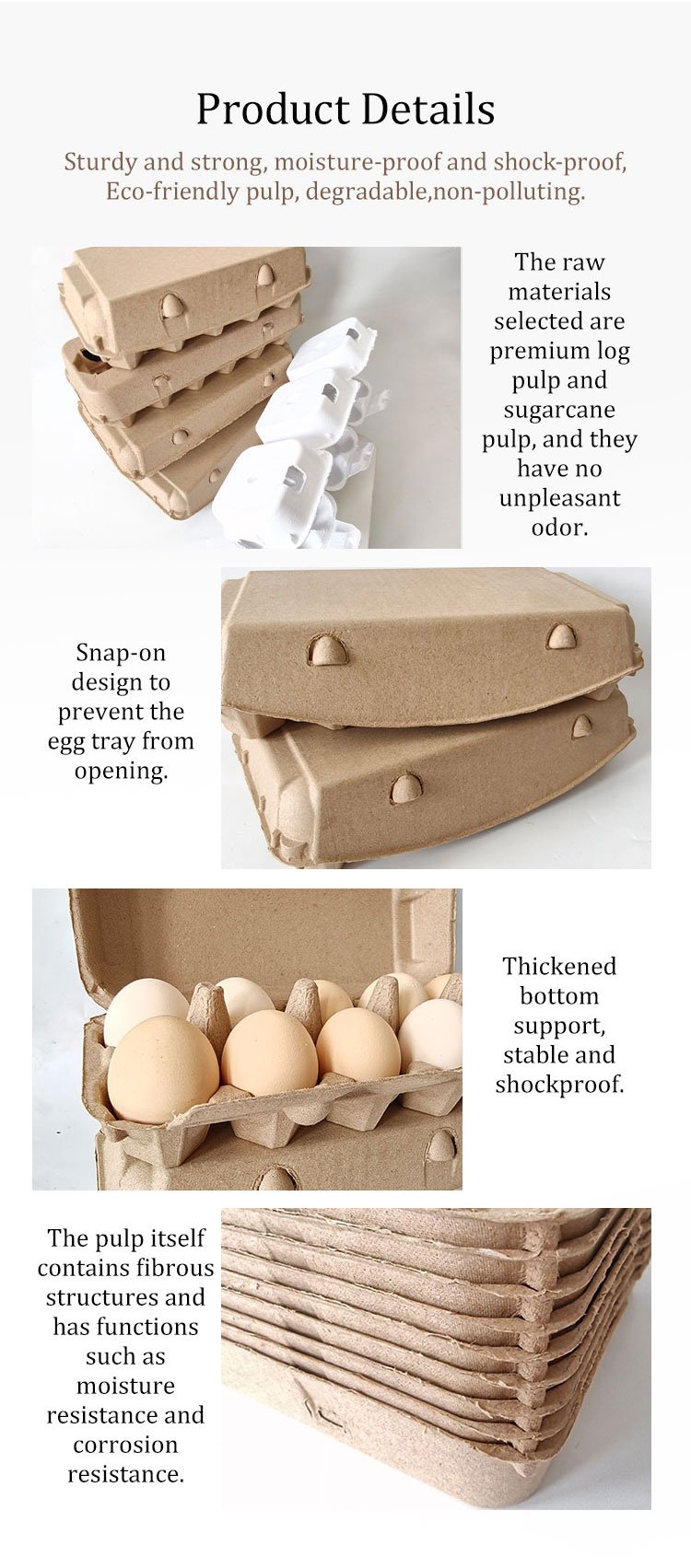
- 100% Biodegradable & Compostable — Made from recycled newspaper and cardboard, our cartons break down naturally. No plastic guilt.
- Superior Shock Absorption — The molded fiber structure cushions each egg individually, dramatically reducing breakage during transport and retail handling.
- Breathable Material — Natural fiber allows air circulation, keeping eggs fresher for longer compared to sealed plastic containers.
- Stackable & Space-Efficient — Designed with interlocking lids and flat tops for stable pallet stacking, maximizing your shipping and shelf efficiency.
- Printable Surface — The matte pulp surface takes stamping, labeling, and light printing beautifully for branding without the premium cost.
Molded Pulp Egg Carton Specifications and Technical Parameters
| Plastic Type | Pulp |
| Shape | Blister Packaging |
| Industrial Use | Agriculture |
| Custom Order | Accept |
| Model Number | 3/4/6/8/10/12/15/18/30 |
| Logo printing | Support |
| Color | Original color / White / Customized color |
| Packing | Standard Export Carton/Pallet |
| Durability | Impact Resistant, High Load Capacity |
| Internal egg specifications | 50~70g |
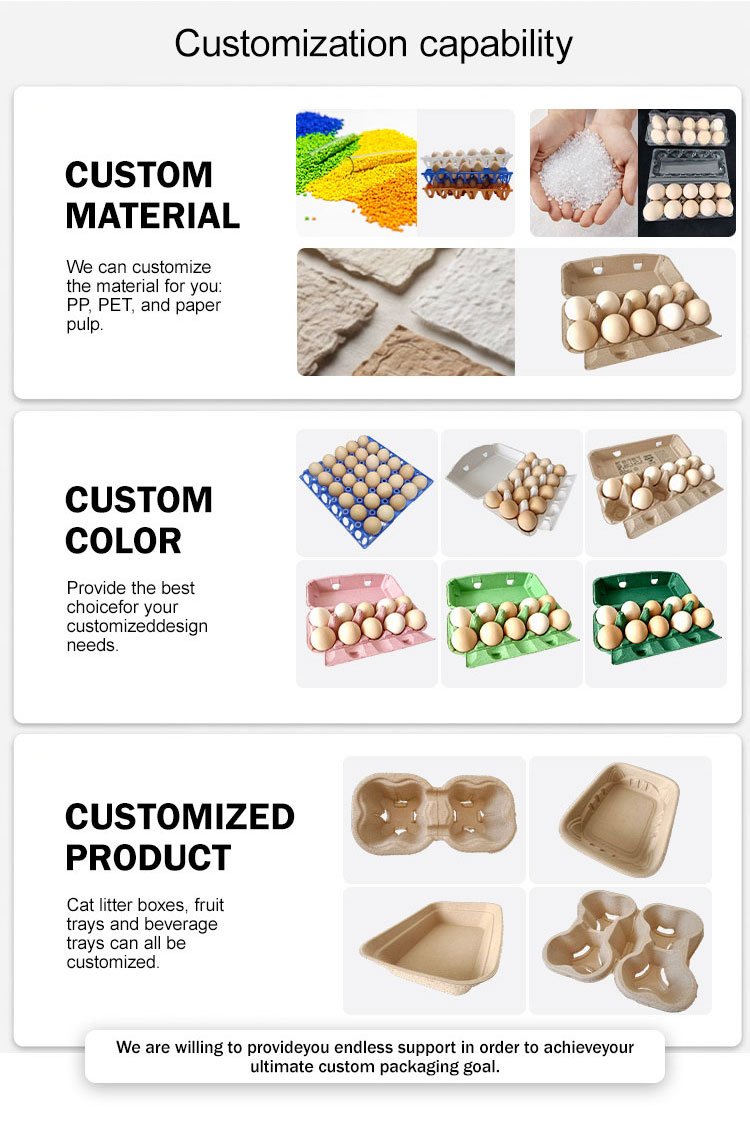
A variety of perfect designs
Are the pulp egg trays biodegradable?
Yes — made from 100% recycled paper fiber, they are fully biodegradable and compostable, breaking down naturally.
What sizes do you offer?
9 sizes: 3, 4, 6, 8, 10, 12, 15, 18 and 30 cells, covering everything from boutique farm stands to high-volume commercial grading plants.
How well do they protect eggs during transport?
Every egg sits in its own molded cradle, so there is no egg-to-egg contact. Shock is distributed through the fiber matrix instead of passing from shell to shell, which is why breakage drops sharply versus flat-packed alternatives.
Can we print our brand on the cartons?
Yes. The matte pulp surface takes logo stamping, pressure-sensitive labels and light flexographic printing — branding without adding a plastic sleeve.
Are the cartons breathable?
Yes. Natural fiber allows air circulation, keeping eggs fresher for longer than sealed plastic containers.
Do you offer samples and wholesale pricing?
Yes. Send your cell count, quantity, print requirement and destination port and we will quote within 24 hours, with samples arranged for stock items.
What is the MOQ for custom-printed pulp egg cartons?
Minimum order quantity depends on the cell count and whether custom printing is required. Plain stock items start considerably lower than fully custom-printed runs — send your specification and we will confirm the exact threshold.
Can you make a custom cell count or outer dimension?
Yes. We hold molds for 3, 4, 6, 8, 10, 12, 15, 18 and 30 cells. If your market needs another size, new tooling is possible — tell us the target dimensions and quantity and we will confirm feasibility and tooling lead time.
What egg weight range do the trays suit?
The standard molds are specified for 50–70 g eggs. Oversized, duck or bantam eggs may need a different pocket depth — always confirm your egg weight range at the quoting stage.
Can pulp egg trays be exported to the US and EU?
Yes, they are routinely exported to North America and Europe. Documentation requirements differ by destination, so tell us the market and we will confirm the applicable food-contact and packaging paperwork before the order is placed.
How should I store pulp egg trays before use?
Keep them dry and off bare concrete. Molded fiber absorbs moisture from humid air, and a damp tray loses stiffness — a dry, ventilated warehouse keeps them at full strength.
Do you supply trays for automatic egg grading lines?
Yes. The 30-cell producer tray is the standard format for grading and packing lines. Tell us your line speed and handling equipment and we will match the tray format and nesting to suit.
Which Cell Count Fits Your Market?
Cell count is the first decision in every pulp egg tray order, because it drives carton dimensions, pallet configuration, retail shelf presence and which buyers you can sell to. We hold molds for 3, 4, 6, 8, 10, 12, 15, 18 and 30 cells, so a distributor can serve farm shops, supermarkets and grading plants from a single supplier instead of juggling three vendors.
| Cells | Eggs per tray | Best for | Typical market |
|---|---|---|---|
| 3 / 4 | 3–4 | Gift packs, sample kits, single-egg tasting sets | Farm shops, gift & hamper makers |
| 6 | 6 | Half-dozen retail packs, small-scale farm sales | Farmers markets, convenience retail |
| 8 | 8 | Regional retail standards in selected EU markets | Specialty grocery |
| 10 | 10 | Standard retail pack in many North American chains | Supermarkets |
| 12 | 12 | The global workhorse — most common retail pack worldwide | Supermarkets, egg producers, brands |
| 15 | 15 | Bulk counter display, bakery and catering use | Foodservice, bakeries |
| 18 | 18 | Restaurant and wholesale catering packs | Foodservice distributors |
| 30 | 30 | Producer trays for grading lines and wholesale supply | Egg grading plants, wholesalers |
If you are launching a brand, 6 and 12 cells usually give the best balance between shelf presence and price per egg. If you supply grading plants or wholesale markets, the 30-cell producer tray is the volume workhorse. Mixed pallets — several cell counts in one container — are routine for us.
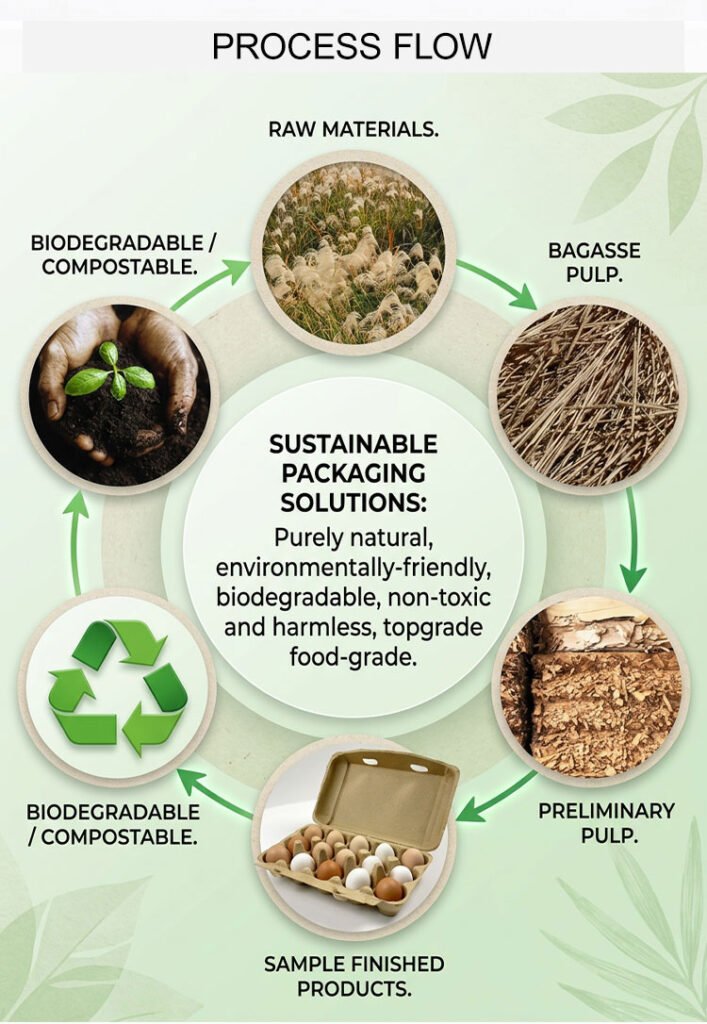
How a Molded Pulp Egg Tray Is Made
Our trays are wet-formed from 100% recycled newspaper and corrugated board — no virgin pulp is required, and no plastic liner or foam insert is used anywhere in the construction. The process runs in six stages:
- Fiber preparation — sorted recycled paper is repulped with water into a consistent slurry.
- Vacuum forming — the slurry is drawn onto a shaped mesh mold, so each egg pocket is formed in a single piece with uniform wall thickness.
- Dewatering — vacuum and pressing remove the bulk of the water while the fiber network is still locked onto the mold.
- Drying — trays pass through a controlled drying tunnel. Moisture content is the single most important variable in final stiffness, so this stage is monitored, not guessed.
- Trimming and nesting check — edges are trimmed and trays are test-stacked to confirm they nest and stack to the agreed specification.
- QC and packing — each production lot is checked for pocket depth, wall integrity, nesting fit and print registration before it is packed for export.
Because the pockets are molded rather than folded, the tray has no seams, staples or glued joints that can fail in transit. That single-piece construction is the reason molded fiber has stayed the default egg protection material for the better part of a century.
Stacking, Load and Breakage Performance
Breakage in egg logistics almost never comes from the egg resting on a flat surface — it comes from eggs touching each other and from point loads during vibration and drop events. Individual molded pockets solve both problems: every egg is held in its own cradle, so shock is distributed across the fiber matrix instead of being transferred egg-to-egg.
Three design features do the heavy lifting:
- Individual cradles — no egg-to-egg contact, so one cracked shell cannot cascade into a whole tray.
- Interlocking lid and base — molded rims seat into the tray above, so a stacked pallet resists lateral shift under braking and cornering.
- Flat, load-bearing top surface — the tray top is designed to carry the weight of the stack above it, which is what lets pulp trays stack more securely than flat-packed alternatives.
A standard 30-cell producer tray carries 1.5–2.1 kg of product at a 50–70 g egg weight, and the tray is engineered to take that load plus the trays stacked on top of it. Because the load path is through the molded walls rather than through the eggs themselves, pulp trays absorb vibration that would transfer straight to the shell in a rigid plastic box.
Molded Pulp vs PET vs EPS Foam
Buyers usually compare three materials. Each has a legitimate place, but they are not interchangeable once retail buyers and regulators get involved.
| Consideration | Molded Pulp | Clear PET | EPS Foam |
|---|---|---|---|
| Material | Recycled paper fiber | Virgin / recycled PET | Expanded polystyrene |
| Biodegradable | Yes — compostable | No | No |
| Accepted in kerbside recycling | Yes (paper stream) | Yes (where PET accepted) | Rarely |
| Breathability | High — natural air flow | None — sealed | None |
| Egg visibility at retail | Low | High | Low |
| Printing & branding | Stamping, labels, light print | Sleeve labels / print | Ink stamping |
| Shock absorption | Excellent — fiber cushions | Moderate — rigid shell | Good but brittle |
| Retailer acceptance | Strong and rising | Good | Declining / banned in many markets |
The practical rule we give buyers: choose pulp when protection, sustainability and retailer acceptance matter most — which is the majority of retail and export programmes today. Choose clear PET when the customer needs to see the eggs, typically premium or gift retail where appearance sells the pack. Avoid EPS foam for any market with active packaging regulation, because single-use foam bans already cover it in a growing number of jurisdictions.
Many of our customers run both: pulp for the standard range and clear PET egg cartons for the premium line. If you are not sure which way to go, send us your retail channel and target price and we will model both.
Export Packing and Container Loading
Molded pulp trays are nested for transport, which is why their shipping volume is so much lower than their finished footprint suggests. Trays are nested in the agreed multiple, packed into standard export cartons on pallets, and moisture-protected for sea freight. Depending on the destination and the buyer’s handling equipment, we quote cartons on pallets, slip-sheets or floor-loaded, and we can print shipping marks and carton labels to your specification.
Every quotation we issue comes with a container loading plan — nesting ratio, cartons per pallet, pallets per 20GP and 40HQ, and total net and gross weight — so you can cost the landed unit price before you commit. If you are consolidating several egg packaging lines, we plan a mixed load so you are not paying for air.
MOQ, Sampling and Lead Time
We are a factory, not a trading company, so the fastest way to a firm price is to send four things: cell count, quantity, print requirement (logo or plain) and destination port. With those we can quote within 24 hours and, for repeat items, hold a production slot immediately.
- Samples — stock items can usually be dispatched quickly so you can test fit and nesting before committing to a full run.
- MOQ — quantity thresholds depend on cell count and whether custom printing is involved; plain stock items start far lower than fully custom-printed runs.
- Custom tooling — if your market needs a cell count or outer dimension we do not already hold, new molds can be tooled — tell us the size and we will confirm feasibility and tooling lead time.
Lead time is quoted per order and depends on whether the item is a stock mold or a new tooling run, plus the current production queue. Because we control the forming, drying and printing stages in house, we can give you a realistic schedule rather than a hopeful one.
Sustainability and Food-Contact Compliance
The sustainability story only works if the food-safety story holds up, and both come from the same raw material. Our trays are formed from recycled paper fiber, contain no plastic lining and no foam insert, and break down naturally at end of life. For food-contact use we can produce to the specification your market requires, and we will confirm the applicable documentation for your destination before the order is placed.
For brands, the matte pulp surface accepts logo stamping, pressure-sensitive labels and light flexographic printing, so you get branded packaging without adding a plastic sleeve that undermines the environmental claim. If you need your sustainability copy to be accurate on pack, tell us at the quoting stage and we will confirm exactly what can be claimed for the material and print you choose.
Buyer’s Checklist Before You Order
- Cell count matched to your retail or wholesale channel, not just to your egg size.
- Egg weight range confirmed — most molds are specified for 50–70 g eggs; oversized or bantam eggs may need a different pocket.
- Print or plain decided before tooling, because print changes both cost and lead time.
- Sample approved physically — check nesting, lid fit and pocket depth, not just a photo.
- Packing format agreed — cartons on pallets, slip-sheets or floor-loaded.
- Loading plan received with the quotation, so landed cost is not a surprise.
- Compliance documents confirmed for your destination market.
- Storage plan in place — keep trays dry and off bare concrete; fiber takes up moisture in humid warehouses.
Related Products and Buying Guides
- Clear PET egg cartons & boxes — 6–30 cells for premium and visible-egg retail.
- Egg packaging for export: 2026 buyer’s guide — trays, packing and compliance, explained stage by stage.
- PET & PP food trays — sushi, prepared meals and takeaway.
- About our factory — 5,000 m² plant in Hengshui, Hebei, exporting worldwide.
- Request a quote — send cell count, quantity, print and destination port.
Molded Fiber or Molded Pulp? The Same Material, Two Names
Buyers in the United States and Canada almost always search for molded fiber egg cartons, while the UK, Europe and much of Asia use molded pulp or moulded pulp. You will also see paper pulp egg trays, fiber egg cartons and fiber-based egg cartons in buying documents. All of these describe exactly what we manufacture here: egg packaging wet-formed from recycled paper fiber, with one molded pocket per egg and no plastic liner or foam insert. If your specification is written using one of these terms and ours uses another, it is the same product — send us your wording and we will quote against it.
Why Demand for Molded Fiber Egg Cartons Keeps Growing
Three forces are pulling egg packaging away from EPS foam and, at the premium end, away from fully rigid plastic:
- Single-use packaging rules. Expanded polystyrene foam is already restricted or banned in a growing number of markets, and retailers do not want to be caught holding a delisted pack. Molded fiber sits on the right side of those rules and is accepted in the paper recycling stream.
- Retailer packaging scorecards. Major grocery chains now score suppliers on recyclability, recycled content and plastic reduction. A recycled-fiber tray improves that score at no extra cost per egg, which is why buyers often switch material before they switch supplier.
- Home delivery and long-distance transport. More eggs are now moved through e-commerce grocery and long-haul export, where vibration and drop events matter more than shelf appearance. Individual molded pockets absorb shock that a rigid shell passes straight through to the egg.
The result is that molded fiber has moved from a bulk commodity for grading plants to a mainstream retail specification — and the same mold serves both, which keeps tooling cost down for buyers running a retail pack and a producer tray side by side.
Custom Molded Fiber Egg Trays: What We Can Change
| Item | Options available |
|---|---|
| Cell count | 3, 4, 6, 8, 10, 12, 15, 18 and 30 cells from existing molds |
| Pocket size | Molds are specified for 50–70 g eggs; tell us your egg weight and grade and we will confirm the correct pocket |
| Fiber mix | Recycled newspaper and corrugated board as standard; alternative fiber blends on request |
| Wall and stiffness | Standard retail weight or heavier export weight for longer stacking in sea freight |
| Colour | Natural grey fiber or white-top finish |
| Branding | Logo stamping, pressure-sensitive label, or light flexographic print in one or two colours |
| Outer packing | Your carton count, shipping marks and pallet format |
| New tooling | If your market needs a cell count or outer dimension we do not hold, new molds can be tooled — send the size for a feasibility check |
Custom work is not only about print. Most of the value in a custom molded fiber egg tray comes from getting the pocket depth and outer dimension right for your egg size and your retail shelf, because that decides how the finished pallet behaves in transit.
Molded Fiber Egg Transport Packaging for Long-Haul Export
For transport rather than retail display, buyers usually choose the 30-cell producer tray because it moves the highest number of eggs per carton and stacks into a stable pallet for container loading. Retail programmes typically run 6-cell and 12-cell packs for the same shipment, and we routinely plan mixed loads so one container carries both.
Trays are nested to a multiple agreed at quoting, packed into export cartons, and moisture-protected for sea freight — fiber takes up moisture in humid warehouses, so keeping pallets dry and off bare concrete matters as much as the tray specification itself. Every quotation includes a container loading plan with nesting ratio, cartons per pallet, pallets per 20GP and 40HQ, and net and gross weight, so you can cost the landed unit before you commit.
Not sure whether your programme should run molded fiber or clear PET? Compare both in PET vs pulp egg tray, or read the egg packaging for export buyer’s guide. To price a molded fiber egg tray order, send cell count, quantity, print and destination port and we will quote within 24 hours.